The Lithic Edit
Mineral Matrix: Collector's Shot (1 Kg)
Mineral Matrix: Collector's Shot (1 Kg)
Couldn't load pickup availability
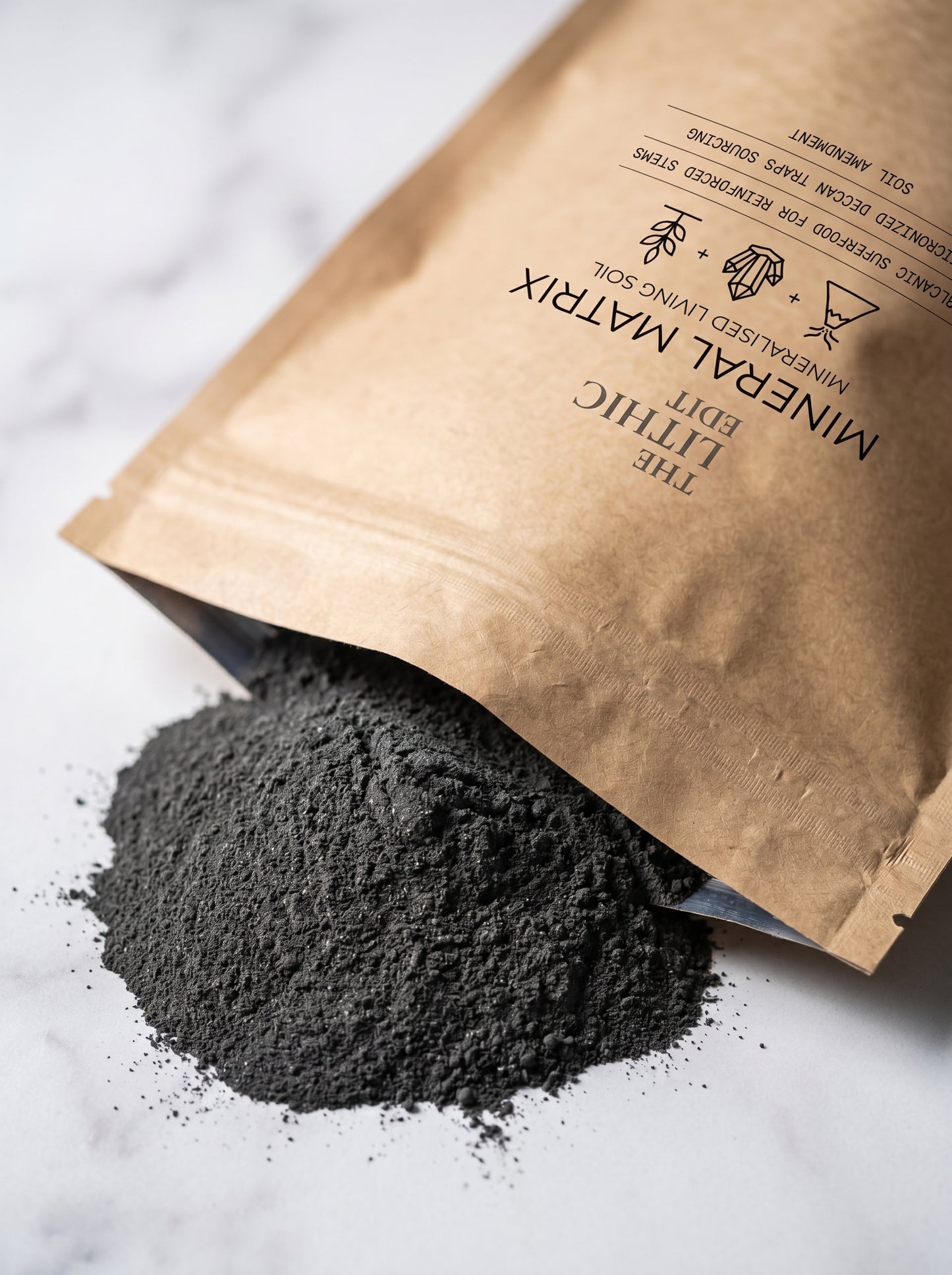
Mineral Matrix: Collector's Shot — 1 Kg of Premium Deccan Basalt for Rare Plant Connoisseurs
The Mineral Matrix Collector's Shot is built for the kind of plant parent who knows what a Monstera Albo Variegata costs, who can tell a Thai Constellation from an Aurea at a glance, and who treats their rarest specimens with the same care a numismatist gives a coin or a sommelier gives a vintage. One kilogram of premium, micronised Deccan basalt rock dust, packed for the collector who has invested in their plants and wants to invest equally in their soil.
Why "Collector's Shot"?
Collectors think differently. They do not buy the fastest fertiliser, the cheapest soil, or the loudest brand. They look for inputs that build long-term value — the kind of substrate decisions that will be visible in the leaves a year from now, not a week from now. The Collector's Shot is sized and positioned for that mindset. One kilogram is the right amount to maintain a curated collection of 15–25 prized specimens for an entire year of careful, considered mineral support — enough to amend every repot, every top-dress, every cutting that gets potted up.
What's Inside
One kilogram of 100% micronised basalt rock dust, sourced from verified Deccan Trap quarries in Maharashtra and Madhya Pradesh — the geological backbone of one of the planet's largest and most mineral-rich volcanic provinces. Each batch is milled to a strict 100–200 mesh (75–150 micron) particle size, sieved for uniformity, dried, and packed without additives, fillers, or synthetic boosters. Just clean, finely powdered volcanic stone — the same kind of mineral input that has built the world's most fertile agricultural soils over geological time.
Typical Mineral Profile
- Silica (SiO₂): 42–50% — reinforces cell walls, regulates stomatal closure, and acts as a botanical bodyguard against abiotic stress.
- Alumina (Al₂O₃): 12–16% — contributes to soil buffering and structural stability.
- Iron Oxide (Fe₂O₃): 10–15% — essential for chlorophyll synthesis and photosynthetic electron transport.
- Calcium Oxide (CaO): 8–12% — critical for cell division and structural integrity.
- Magnesium Oxide (MgO): 5–10% — the central atom of every chlorophyll molecule.
- Trace Elements: 1–2% — the catalytic spectrum that drives enzymatic reactions and natural plant immunity.
This typical profile reflects standard Deccan basalt and is offered as a slow-release mineral reservoir, not a quick-acting fertiliser.
Why Collectors Choose Rock Dust
Variegated aroids — Monstera Albo, Thai Constellation, Philodendron Florida Beauty, Anthurium clarinervium — are structurally vulnerable plants. The white or yellow sectors of their leaves contain little or no chlorophyll and are weaker than the green tissue. They tear more easily, brown faster at the edges, and are more sensitive to drought, heat and pest pressure. Silica, the dominant element in basalt, plays an increasingly recognised role in stabilising these tissues. By feeding silica into the substrate over months, you give the plant raw material to reinforce its cell walls in exactly the places that need reinforcement.
For collectors of Hoyas, Anthuriums, Alocasias, Calatheas and other tropical specimens, the same principle applies. Silica-fortified plants tend to show stiffer petioles, glossier leaves, better recovery after stress, and improved resilience to indoor conditions — dry air, inconsistent humidity, occasional draughts, and the inevitable spider mite outbreak.
The Slow-Release Advantage
A collector's plant is rarely repotted on a fixed schedule. Some specimens stay in the same pot for two years; others get propagated, divided, and repotted constantly. Synthetic NPK fertilisers cannot be timed neatly to this rhythm — they spike and fade. Rock dust is different. The minerals locked inside each basalt particle release slowly, over many months, as soil acids and microbes etch the surface of the rock. The substrate becomes a steady mineral background that does not depend on you remembering to fertilise on a particular Tuesday. For collectors managing dozens of plants on different rotations, that consistency is invaluable.
Coverage and Use
One kilogram of Mineral Matrix is enough to:
- Top-dress approximately 40–60 medium pots over a year
- Amend up to 60–80 litres of fresh potting mix at the recommended blend ratio
- Sustain a 15–25 plant collection for a full year of mineral support
- Last a serious propagation programme through multiple cutting cycles
How to Use the Collector's Shot
- Repotting Blend (best results): Mix 1–2 tablespoons per litre of potting mix when repotting. Stir thoroughly so the powder is evenly dispersed.
- Top-Dress (maintenance): Sprinkle 1–2 teaspoons per 6–8 inch pot every 2–3 months. Water in.
- Propagation Boost: Add a small pinch to the substrate when potting up rooted cuttings — new roots benefit from immediate access to trace minerals.
- Aroid Mix Custom Blend: Add 5–10% by volume to your custom aroid mix alongside bark, perlite/pumice, charcoal and worm castings.
- Variegated Specimens: Apply with the rest of your routine — silica builds in the leaves over months, not weeks.
Mineral Matrix is non-burning and pH-neutral to mildly basic. It cannot be over-applied in the way synthetic fertilisers can, and it is fully compatible with whatever liquid feed you already use.
Best For
- Variegated aroids: Monstera Albo, Thai Constellation, variegated Philodendron, Aglaonema
- Anthurium collectors: clarinervium, warocqueanum, magnificum, regale
- Alocasia, Caladium, Colocasia specimens
- Hoya and Dischidia collections
- Rare Philodendrons — spiritus-sancti, gigas, melanochrysum
- Calathea, Maranta, Stromanthe enthusiasts
- Bonsai growers focused on long-term substrate health
Living Soil for the Discerning Grower
Rock dust performs best in the company of biology. The organic acids released by microbes, mycorrhizae and earthworms slowly etch minerals out of basalt particles, releasing iron, magnesium, calcium and silica in plant-available forms. If you already maintain a biologically active substrate — worm castings, mycorrhizal inoculant, fish emulsion, neem cake — the Collector's Shot completes your loop. It becomes the mineral reservoir that feeds the microbes that feed your most prized plants.
Sourcing, Processing & Compliance
Every batch is sourced from verified Deccan basalt quarries, milled on calibrated equipment to 100–200 mesh, sieved for uniformity, and dried before packing. The product is screened for foreign matter and is produced in line with India's Fertilizer Control Order (FCO) framework for soil conditioners and mineral amendments, including limits on Arsenic, Cadmium, Chromium, Mercury and Lead.
Handling & Safety
Mineral Matrix is a fine mineral powder. Please avoid inhaling the dust during application — wear a simple dust mask when mixing larger volumes, work in a ventilated area or outdoors, and wash hands after use. Once incorporated into soil, the product is non-toxic and safe around pets and children.
Pack Details
- Net Weight: 1 Kg
- Particle Size: 100–200 mesh (approx. 75–150 microns)
- Origin: Deccan Traps, India
- Ingredients: 100% micronised basalt rock dust. No additives.
- Coverage: 40–60 medium pots (top-dress) or 60–80 L of substrate (blend)
- Shelf Life: Indefinite when stored dry and sealed.
The Lithic Edit Promise
India's Deccan Traps are one of the great untapped horticultural resources of the modern world. The Collector's Shot is our offering to the people who care most about getting that resource into their pots — the collectors, the connoisseurs, the growers who treat soil as the foundation of everything that matters in their plant care. Pour with intention, store with care, and let the silica do its slow, patient work.
Share